
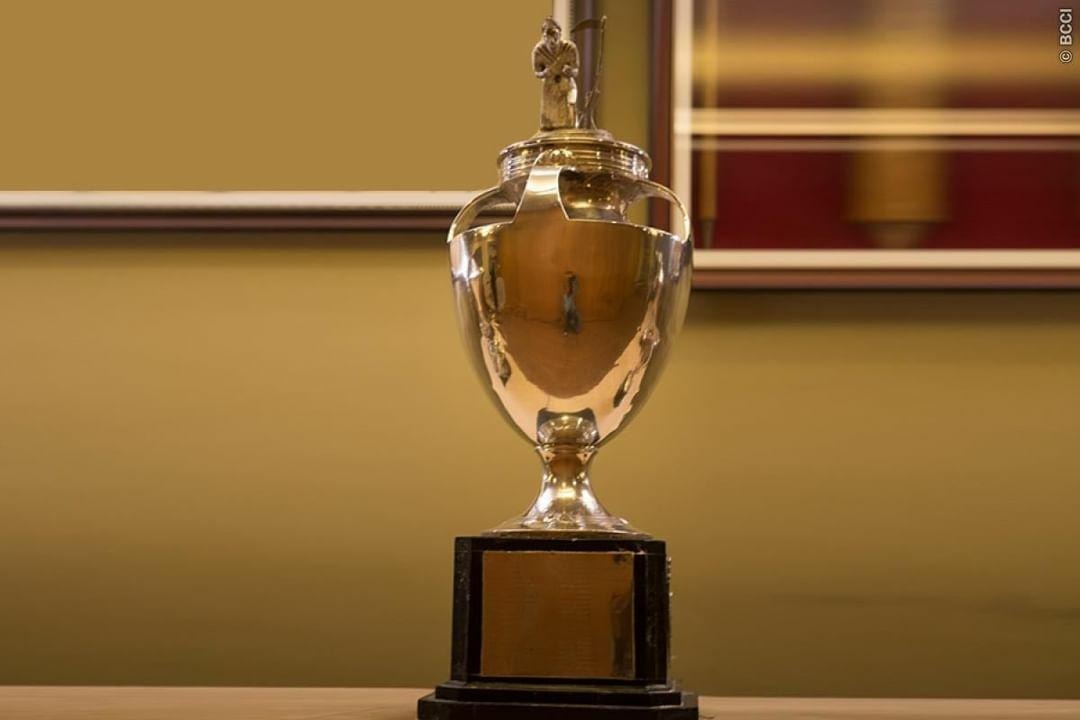
The Ranji Trophy is one of India’s most prestigious domestic cricket competitions. Its five-day final often tests the patience, skill and endurance of both teams. However, not every final produces an outright victory.
So, what happens if the Ranji Trophy final ends in a draw? Does the trophy get shared, or does one team become champion?
The answer is straightforward when one team has secured a first-innings lead. If the Ranji Trophy final ends without an outright result, the team with the higher first-innings total is declared the champion.
This rule makes the first innings extremely important. A team does not necessarily need to bowl out its opponent twice or chase a target to lift the trophy. Securing more runs than the opposition in the first innings can be enough.
The rule received major attention during the 2025–26 Ranji Trophy final between Jammu and Kashmir and Karnataka. Jammu and Kashmir secured their maiden Ranji Trophy title despite the match ending in a draw.
Here is how the rule works, what happens in different match situations, and why the first innings can decide the championship.
What Happens If the Ranji Trophy Final Draws?
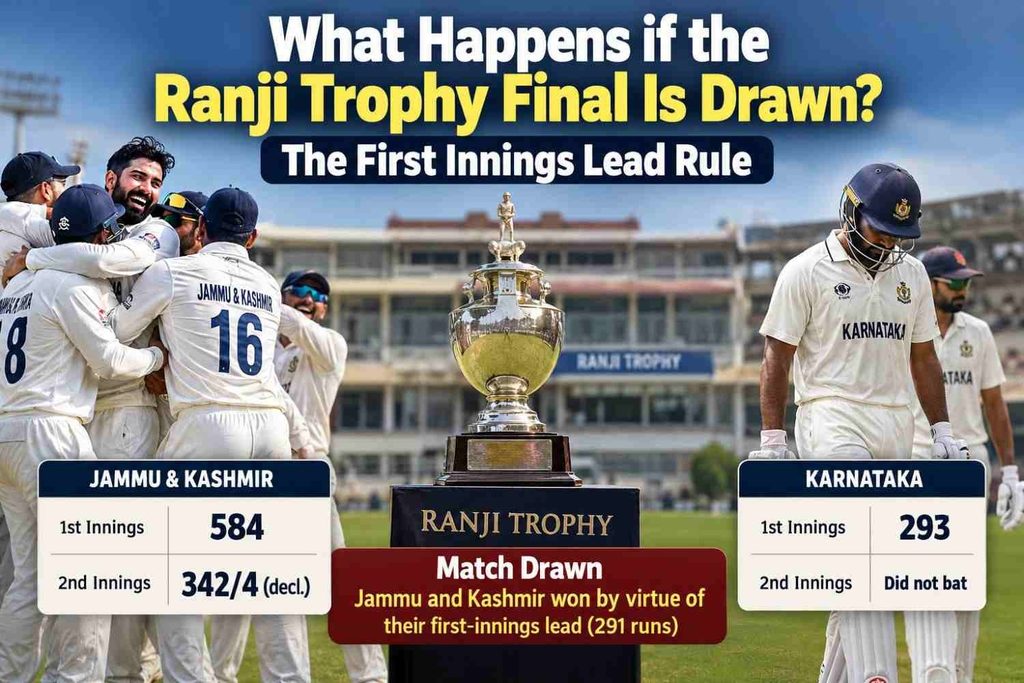
If the Ranji Trophy final finishes in a draw after the scheduled playing days, the team with the higher first-innings total wins the championship.
A drawn final does not automatically mean both teams share the trophy. When one team has secured a first-innings lead, that team is declared the champion.
For example, if Team A scores 450 runs in its first innings and Team B scores 380, Team A secures a 70-run first-innings lead. If the match subsequently ends in a draw, Team A wins the Ranji Trophy.
Even if Team B scores more runs in the second innings, that does not change the first-innings advantage.
The important factor is the comparison between the two teams’ first-innings totals.
How Does the First Innings Lead Rule Work?
A first-innings lead is the difference between the runs scored by the two teams in their first innings.
The team batting first establishes its first-innings total. The team batting second must score at least one run more to secure a first-innings lead.
Here are three possible situations:
| First Team Score | Second Team Score | First Innings Result |
| 450 | 451 | Team B takes a 1-run lead |
| 500 | 480 | Team A takes a 20-run lead |
| 350 | 350 | Scores are level |
If Team B scores 451 after Team A makes 450, Team B takes the first-innings lead. If the match subsequently ends in a draw, Team B becomes the champion.
Similarly, if Team B scores only 449, Team A retains the first-innings advantage.
The second-innings scores do not replace or change the first-innings lead.
What If Both Teams Have the Same First Innings Score?
An equal first-innings score does not give either team a lead.
If both teams finish their first innings with exactly the same number of runs, neither side has established a first-innings advantage.
The 2019–20 BCCI Men’s Multi-day Playing Conditions addressed this situation under Clause 16.9.3. They specified that both teams would be declared joint winners if no first-innings result was obtained by the scheduled final day, the first-innings scores were equal, or the first-innings result was a tie.
This was the specific provision for the 2019–20 season. It should not be assumed to apply automatically to later seasons.
What Happens If the First Innings Is Not Completed?
An incomplete first innings is another important situation in a drawn Ranji Trophy final.
Suppose Team A scores 400 runs, but rain and bad light prevent Team B from completing its first innings. Team B has scored 250 runs when the scheduled final day ends.
In this situation, the first-innings result has not been established. Team A cannot automatically be declared the champion simply because it has scored more runs.
The outcome must be determined using the knockout playing conditions for that particular season. A team cannot claim the championship solely on the basis of an incomplete first-innings score.
Ranji Trophy Final 2026: How Jammu and Kashmir Won Despite a Draw
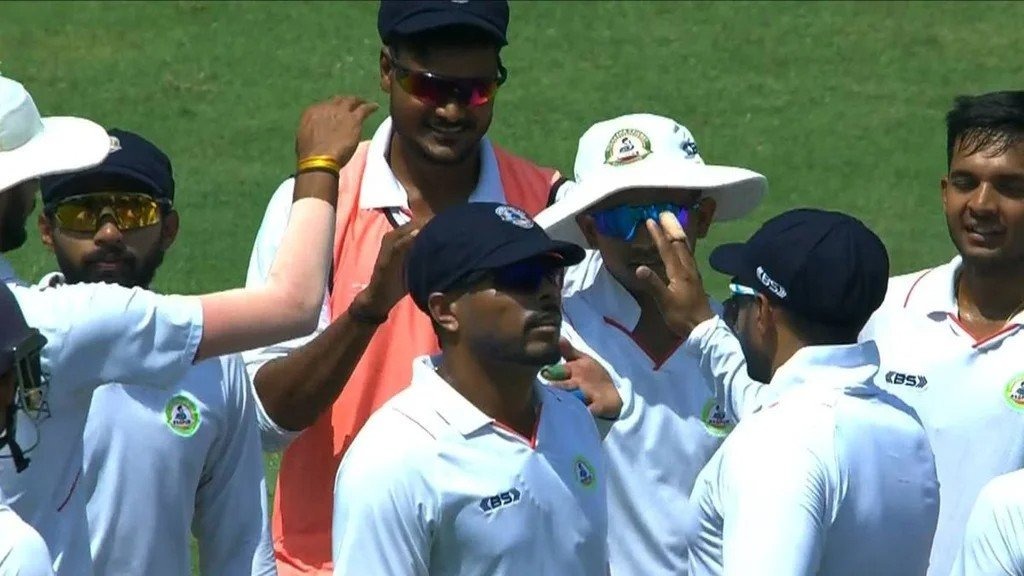
Source Image: Jansatta
The 2025–26 Ranji Trophy final provided a perfect example of the first-innings lead rule.
Jammu and Kashmir faced eight-time champions Karnataka in their maiden appearance in the Ranji Trophy final. J&K produced a commanding batting performance and scored 584 runs in their first innings.
Karnataka struggled in reply. Despite Mayank Agarwal’s impressive 160, the team was bowled out for 293.
This gave Jammu and Kashmir a massive 291-run first-innings lead.
Instead of enforcing the follow-on, J&K chose to bat again. Qamran Iqbal scored an unbeaten 160, while Sahil Lotra contributed an unbeaten 101. Jammu and Kashmir declared at 342 for 4 in their second innings.
The two captains eventually agreed to end the contest in a draw on the fifth day.
However, the result was not a shared championship. Jammu and Kashmir won the title because of their first-innings lead.
The final was played from 24 to 28 February 2026 at the KSCA Hubli Cricket Ground in Hubballi. Jammu and Kashmir captain Paras Dogra collected the Ranji Trophy from BCCI President Mithun Manhas.
After the historic victory, Dogra expressed his emotions, saying, “I cannot explain and I don’t have any words.” He described the triumph as the biggest moment of his life.
Ranji Trophy 2025–26 Final Scorecard
| Team | First Innings | Second Innings |
| Jammu and Kashmir | 584 | 342/4 declared |
| Karnataka | 293 | Did not bat |
Final Result: Match drawn. Jammu and Kashmir won by virtue of a 291-run first-innings lead.
Key Performances in the Final
| Player | Team | Performance |
| Shubham Pundir | Jammu and Kashmir | 121 runs (first innings) |
| Mayank Agarwal | Karnataka | 160 runs (first innings) |
| Qamran Iqbal | Jammu and Kashmir | 160* (second innings) |
| Sahil Lotra | Jammu and Kashmir | 101* (second innings) |
| Auqib Nabi | Jammu and Kashmir | 5/54 (Karnataka’s first innings) |
| Prasidh Krishna | Karnataka | 5/98 (J&K’s first innings) |
Shubham Pundir was named Player of the Match for his contributions of 121 runs in the first innings and four runs in the second innings.
The victory was historic. Jammu and Kashmir won their first Ranji Trophy title, 67 years after making their debut in the competition in the 1959–60 season. Their 291-run first-innings advantage proved decisive, even though Karnataka managed to avoid an outright defeat.
Why Is the First Innings So Important in a Ranji Trophy Final?
The first innings often shapes the entire strategy of a five-day Ranji Trophy final.
The 2025–26 final between Jammu and Kashmir and Karnataka demonstrated why an early first-innings advantage can decide the championship.
Karnataka suffered a dramatic collapse during their first innings. KL Rahul was dismissed when the team score was 27, followed by Devdutt Padikkal at 56. Karun Nair and Ravichandran Smaran were dismissed at 57, leaving Karnataka struggling at 57/4 after 18 overs.
KL Rahul scored 13 runs, while Padikkal made 11. Mayank Agarwal then produced an outstanding recovery, scoring 160 runs from 266 balls. His innings helped Karnataka reach 293, but the team still finished 291 runs behind Jammu and Kashmir.
This situation showed how important the first innings can be. Even though Karnataka recovered from 57/4 and avoided an outright defeat, its first-innings deficit meant it could not win the championship.
Unlike limited-overs cricket, a first-class match gives teams more time to build an advantage. A strong first-innings total can put pressure on the opposition and provide a safety net if the match runs out of time.
There are several reasons why teams focus heavily on the first innings.
1. Building a Substantial Total
The team batting first wants to score as many runs as possible. A total of 450 or 500 can create significant pressure on the opposition, particularly when the pitch starts helping the bowlers.
2. Securing the First Innings Lead
The team batting second must try to cross the opponent’s first-innings total. Even a one-run lead can become valuable if the match ends in a draw.
3. Managing the Follow-on Decision
Under the 2025–26 BCCI Men’s Multi-day Playing Conditions, the team batting first can enforce the follow-on when it secures a lead of at least 200 runs in a five-day match.
However, enforcing the follow-on is a tactical decision. A captain may prefer to bat again, increase the lead and reduce the opposition’s chances of winning.
The 2025–26 Ranji Trophy final demonstrated this decision. Jammu and Kashmir had a 291-run lead but chose to bat again instead of enforcing the follow-on.
4. Protecting the Advantage on the Final Day
When a team has secured a first-innings lead, it can approach the remaining match differently. The captain may prioritise defensive field placements, disciplined bowling and controlling the scoring rate rather than taking unnecessary risks.
Is the Ranji Trophy Final Rule Different From League Matches?
Yes. This is an important distinction.
The Ranji Trophy has a league stage followed by knockout matches. A drawn league match and a drawn final do not have the same consequences.
In league matches, teams receive points according to their match result and first-innings performance.
Under the 2025–26 men’s competition points system, the points awarded in drawn matches depend on the first-innings result.
| League Match Situation | Points Awarded |
| Draw with a first-innings lead | Leading team: 3 points |
| Draw with a first-innings deficit | Trailing team: 1 point |
| Draw without a first-innings result | Both teams: 1 point each |
| Draw with a tied first innings and no outright result | Both teams: 1 point each |
However, in the knockout final, a first-innings lead can determine the champion when the match finishes without an outright result.
| Match Situation | Consequence |
| League match with a first-innings lead and a draw | Leading team receives 3 points |
| League match without a first-innings result | Both teams receive 1 point each |
| Final with a first-innings lead and a draw | Team with the lead wins the championship |
| Final with an outright victory | Winning team becomes champion |
| Final with equal or incomplete first innings | Outcome depends on the applicable season’s final playing conditions |
Therefore, a first-innings lead in a league match does not automatically mean a team has won the match. It simply gives that team a better points return.
The knockout final is different because the first-innings lead can decide who lifts the trophy.
Can Both Teams Share the Ranji Trophy After a Draw?
A drawn Ranji Trophy final does not automatically result in a shared trophy.
When one team has established a first-innings lead, that team receives the championship if the match ends without an outright result.
However, situations such as an equal first-innings score or an incomplete first innings require reference to the specific season’s knockout regulations.
The 2019–20 playing conditions provided for joint winners in specified situations, but those historical provisions should not be assumed to apply unchanged to every subsequent Ranji Trophy season.
Conclusion
The first-innings lead rule plays a decisive role in determining the Ranji Trophy champion when the final ends in a draw. The team that scores more runs in its first innings earns the advantage and can lift the trophy without securing an outright victory.
Jammu and Kashmir demonstrated this perfectly in the 2025–26 final against Karnataka. Their 291-run first-innings lead secured their maiden championship despite the match finishing in a draw.
However, situations involving equal first-innings scores or an incomplete first innings must be judged according to the relevant season’s BCCI knockout playing conditions.
For teams competing in the Ranji Trophy final, scoring heavily in the first innings is not just about building a competitive total. It can be the difference between winning the championship and finishing as runners-up.
Frequently Asked Questions
The team that secures the first-innings lead is declared the champion if the final ends without an outright result. The trophy is not automatically shared.
Yes. A one-run lead is sufficient to establish a first-innings advantage. If the match subsequently ends in a draw, that team wins the championship.
Neither team has a first-innings lead. The result must be determined using the applicable season’s knockout playing conditions.
Yes. A team can become champion even if the match is officially recorded as drawn. Securing the first-innings lead is enough when no outright result is achieved and the applicable playing conditions provide for the leading team to win.
The Ranji Trophy final is traditionally scheduled over five days. The 2025–26 final between Jammu and Kashmir and Karnataka was played from 24 to 28 February 2026.